Join Gigpit!
Save your favourite local artists, post a show, or create your own artist page.
Beta Feature: The Gigpit Genre Map
An interactive map of the artists and genres in the Gigpit database.
Orb size
Add yourself to the map
Join the 1490 Canadian artists across 813 genres with a Gigpit artist page
So what the hell is this?
Over the past couple of years working on Gigpit, I’ve become extremely interested in algorithms. It’s a bit of a love-hate relationship.
The Problem with Algorithms
On one hand, everyone wants a world where it’s easy to find the things they like. Whether that’s music, a movie, or a new shirt.. being able to discover things you enjoy is obviously useful.
The problem is how limiting “the algorithm” actually becomes. In the tool above, try making the orb as small as possible and move it around the map. You’ll notice that lots of genres only contain a few artists. That’s because our database is limited. We’re focused on local artists, and we haven’t documented everyone yet.
Now imagine what this chart would look like with the database of Spotify. You could make the orb as tiny as you want and there would still be thousands of artists in every direction.
Once Spotify figures out your bubble, it will keep showing you music inside that same tiny orb over and over again. And it’s surprisingly hard to escape it.
At first this feels great. Every song is something you like. But something else happens too. You stop paying attention to who you’re listening to. There’s no reason to remember the artist’s name when the next song is going to be just as acceptable.
Over time, listeners become fans of playlists rather than fans of artists.
The Economic Consequences
Streaming platforms don’t pay artists very much, and because the system is based on payment per stream, artists are rewarded for making music that is as digestible and replayable as possible.
In the past, a middle class musician could build a sustainable career by selling a few thousand records, playing regular shows, and building a dedicated fanbase.
Now, if you get 1,000,000 plays on a song you make about $3,000. Getting that many plays is so challenging. It takes a serious banger, and significant investment in production and marketing. $3k probably won't even cover the production costs, but it definitely won't cover your rent as well.
The result is a kind of musical middle-class collapse.
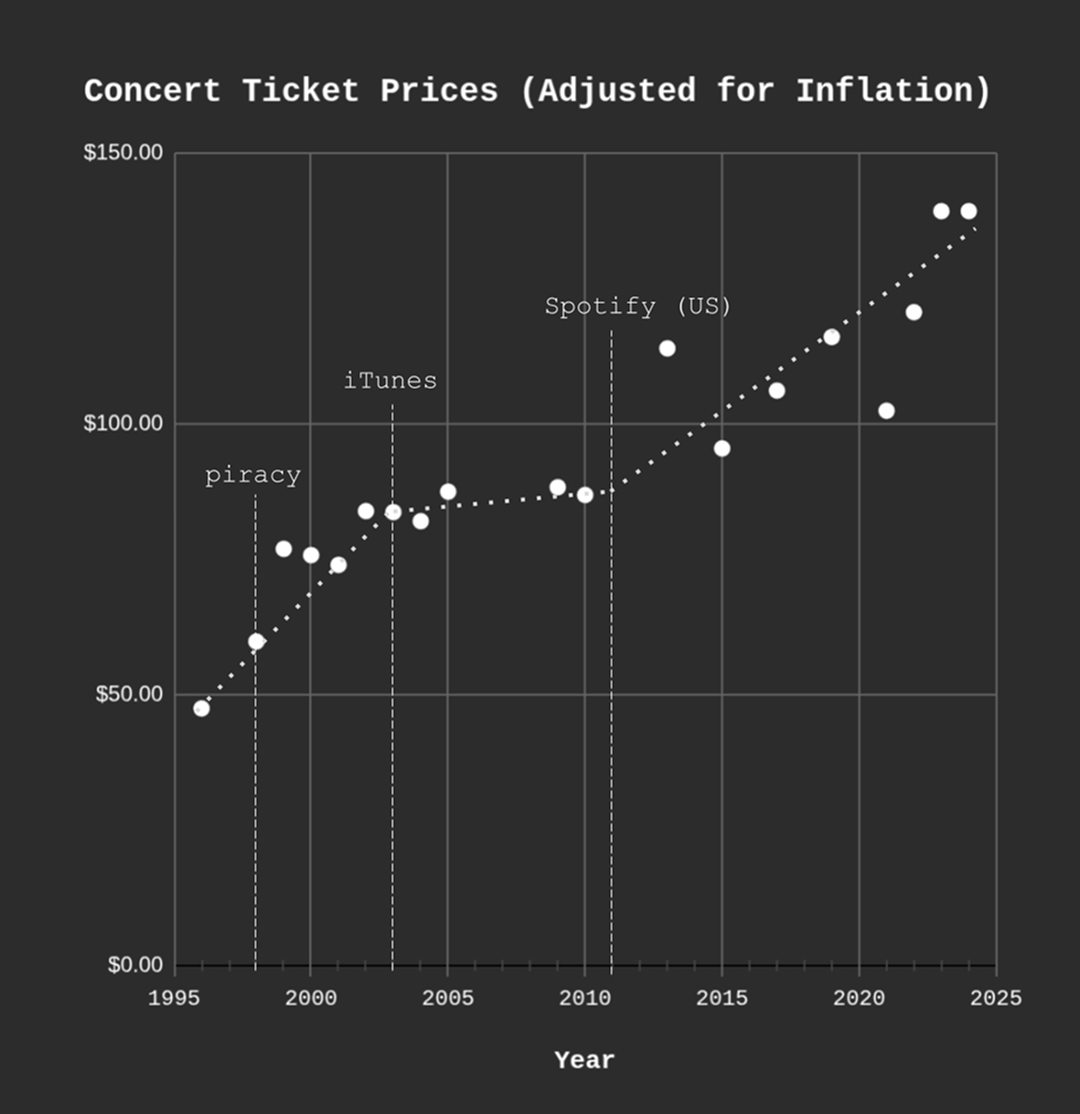
As those artists disappear, the ecosystem around them weakens too. Small promoters and venues have fewer viable touring acts, and the live music economy becomes more dependent on large touring artists.
That pushes ticket prices higher: artists still have to make money somewhere.
How does this tool work?
Do you want the general explanation or the more technical one?
When we started Gigpit, we wanted to experiment with a different approach to discovery.
The tool above is one of the first examples we’ve built. It’s not perfect, and we don’t really want it to be.
There are no popularity metrics in this system. Artists aren’t recommended differently because they’re more famous or have more streams.
Instead, artists are placed on the map using only the information they provide about themselves: their band name, image, genres, and description.
From there, it’s up to listeners. You decide how big your search area is and what sounds interesting.
Why the local aspect matters
Once you discover an artist you like, the next step is usually to go see them play.
That’s why the local aspect of music matters so much. Most of the artists in our database are small and aren’t touring the country very often. The best chance you have to experience their music is when they’re playing in your own city.
Our goal is to keep expanding the database across Canada so that discovering the music in your own backyard becomes easier, more surprising, and more fun.
Looking for music locally is the way of the past, but we want it to be possible in the future.
If you have any questions or feedback, please feel free to contact me:
Aidan Polglase
Co-founder of Gigpit
Email: [email protected]
Some artists in your sphere
Move the sphere over genres to see artists.